

What Is Requirements Engineering?
Requirements Engineering (RE) is the systematic process of eliciting, analyzing, documenting, and managing requirements for a system, product, or software solution. Its goal is to translate the needs of different stakeholders into clear, complete, and actionable requirements that provide a reliable foundation for development – whether using agile methods, the traditional waterfall model, or a hybrid approach.
Closely related, but not identical, is Requirements Management. While Requirements Engineering focuses on the initial, systematic elicitation and analysis of requirements, Requirements Management ensures their ongoing maintenance, version control, and traceability throughout the entire project lifecycle. Professional Requirements Engineering consulting combines both perspectives.
Requirements are generally divided into two categories: functional requirements define what a system should do, while non-functional requirements specify quality attributes such as security, performance, and usability, as well as regulatory constraints. Professional Requirements Engineering consulting ensures that both types of requirements are captured completely and consistently from the outset – based on recognized standards such as the IREB® Certified Professional for Requirements Engineering (CPRE) model.
Why Requirements Engineering Consulting Pays Off
Without a structured approach to requirements, projects face significant risks: overlooked or incomplete requirements, outdated specifications, conflicting versions, and a lack of transparency around dependencies and interfaces. Correcting issues later in the development process is significantly more expensive than clarifying requirements early on. Studies indicate that professional Requirements Engineering can reduce development costs by up to 30%.
| Without Structured Requirements Engineering | With Professional Requirements Engineering |
|---|---|
|
|
Capturing Requirements Holistically – Key Sources
Requirements rarely come from a single source. To ensure that nothing is overlooked, we systematically consider all relevant sources:
| Stakeholders | Documents | Existing Systems |
|---|---|---|
End users, sponsors and management, development teams, customers, and regulatory authorities. | Process documentation, regulatory requirements, internal policies, and market and user research. | Legacy and predecessor systems, competitor solutions, and internal and external interfaces. |
Our Approach
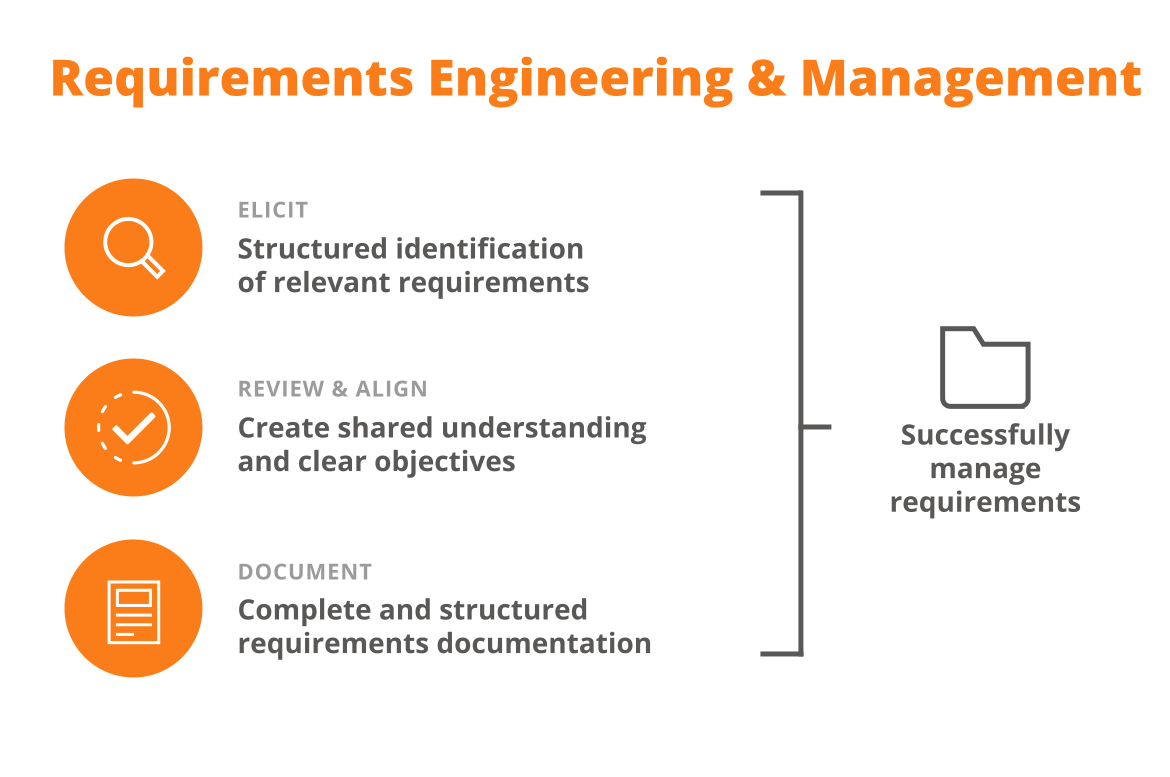
Our approach follows a proven, iterative process that combines established requirements elicitation techniques with modern, agile, and AI-supported methods. It always starts with a clear definition of objectives: before gathering requirements, we work with you to define the underlying business goals – because understanding why a requirement exists is essential to prioritizing it effectively.
-
Requirements Elicitation
We elicit requirements through structured interviews, facilitated workshops using creative techniques such as brainstorming and role-playing, observation of real-world usage scenarios, and analysis of existing documents and systems (“system archaeology”).
-
Analysis & Consolidation
Through in-depth analysis sessions and facilitated focus groups, we use cognitive techniques to build consensus, assess requirements for feasibility, completeness, and consistency, and resolve conflicts between different stakeholder perspectives. Visual models such as diagrams, mind maps, and scenarios help establish a shared understanding.
-
Documentation & Prioritization
Requirements are documented in a clear, testable, and traceable manner and prioritized using methods such as MoSCoW. To ensure end-to-end traceability, we use tools such as DOORS, Polarion, codebeamer, or Jira, depending on the project.
-
Validation & Continuous Adaptation
Through rapid prototyping and reviews, we make requirements tangible and testable before development begins. In agile projects using Scrum or Kanban, requirements are iteratively refined in sprints and continuously adapted to changing conditions.
Our Requirements Engineering Services
Assessment of Your Requirements Process
We assess your existing roles, processes, and tools and identify specific opportunities for im
Structured RE Processes & Tool Selection
We establish scalable requirements management processes tailored to your organization, including the right toolchain.
AI-Assisted Requirements Analysis
Modern NLP methods help automatically identify gaps and inconsistencies in specifications and assess requirements for completeness.
Training & Coaching
We empower your teams to independently elicit, manage, and implement requirements in line with recognized standards.
Operational Requirements Management
If required, we take care of the ongoing maintenance, management, and modification of your requirements as part of day-to-day operations.
Requirements Engineering for Regulated Industries
We derive standards-compliant requirements based on ISO 26262 and ASPICE for automotive, IEC 62304 and MDR for medical technology, as well as industry-specific regulations for financial services.


Whether you are driving digital transformation, implementing new IT systems, or optimizing processes, we turn complex requirements into clear solutions. Leverage our expertise to make your projects more efficient, transparent, and future-ready.
Now is the right time to take the next step. Ready to take your requirements to the next level? Contact us for a no-obligation consultation.
Request Requirements Engineering Consulting

Talk to us.
Michael Fahmüller
Product Line Manager Professional Services
Talk to us.
Michael Fahmüller
Product Line Manager Professional Services